
Solar System - Fine Arts Edition
OPENING QUESTIONS: We discussed the early, and VERY chaotic, life of our solar system yesterday where planets 'cleared' their orbits by colliding with other objects.
Astronomers believe that there were probably two dozen or so planet sized objects early in that time period.
One of those planets that survived a massive collision with another planet was the Earth. It *smacked* into a Mars-sized planet (named "Thea") that almost destroyed the Earth and *did* destroy Thea.
What impacts did that collision have on Earth that we still notice today? Suggest at least three and then work with your team to rank those from most to least profound.
OBJECTIVE: I will be able to relate how the solar system was formed to an articulate 6th grader after today's class.
WORD FOR TODAY:
- solar nebula (star nursery)
- super nova (exploding star)
- Sol ("Our Sun")
- Asteroid ("Rocks in space" otherwise known as "Flying Potatoes" )
- Comet ("A dirty snowball")
- Meteor ("Rocks falling to Earth")
- Moon ("A rocky body orbiting a planet")
- Planet ("A spherical body orbiting a star")
- Mercury
- Venus
- Earth
- Mars
- Jupiter *(has rings!)
- Saturn *(has rings!)
- Uranus *(has rings!)
- Neptune *(has rings!)
- Dwarf Planet:
- Pluto
- Eris
- Haumea
- Astronomical Unit (1 AU = 150,000,000 km = ~ 100,000,000 miles)
Thea ("Smacked into Earth, nearly destroying our planet")
OBSERVATIONS: It was cold but CLEAR last night, we got some very cool pictures and now comes the image processing phase, that usually takes a few days.
We are ON for tonight too (Be sure and dress a whole lot warmer than you think you should. In fact bring a blanky!)
WORK O' THE DAY:
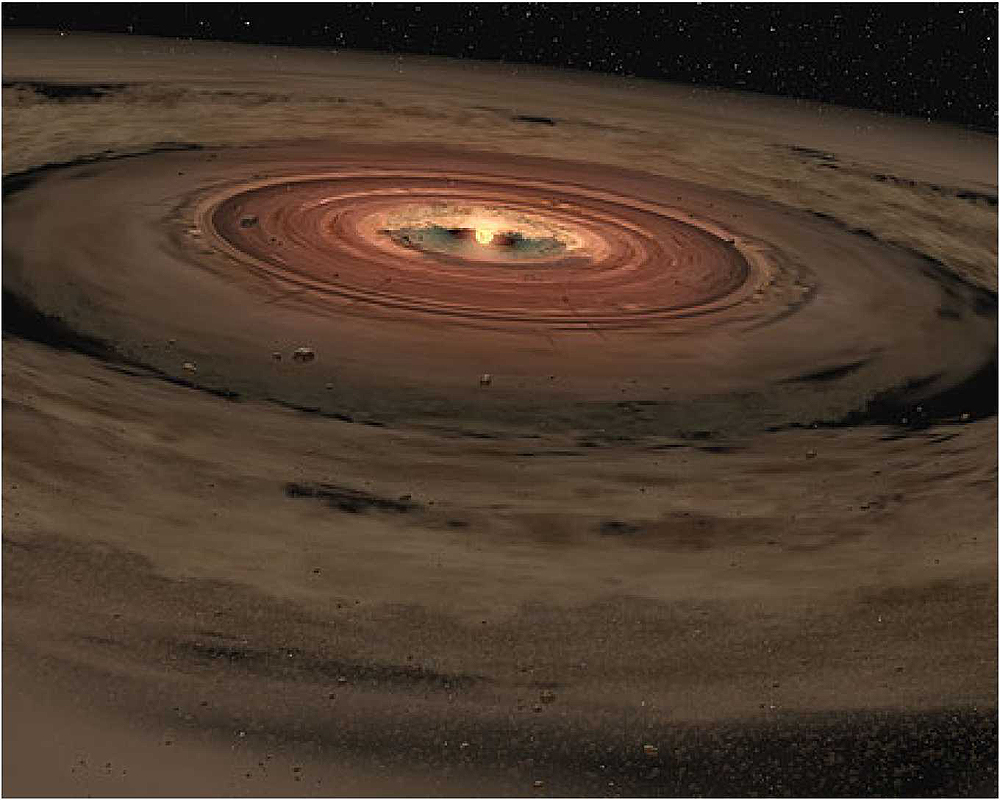
Recall the cosmic whirlpool that was our early solar system:
═══════════════════════════
About 3.5 billion years ago, a Mars-sized planet name Thea smashed into our Earth, almost destroying the Earth:

The heavier materials such as nickel and iron migrated towards the center of the Earth forming a dense, solid core.
The lighter materials shot into nearby space and eventually coalesced into the moon!
Let's discuss!
═══════════════════════════
FINE ARTS Edition:
-
Work with your team to choose a topic from our general list of objects (See Words' O' The Day above) and do just a wee bit of research on that topic. Don't read for content, just scroll and look for interesting tidbits that catch your eye.
-
Then choose one specific object from that category and do a wee bit more research. Not *quite* reading for content but getting enough information so that you have a pretty good idea of the specifics of that object.
-
Then work with a partner (if there are 4 in your group) or with 3 if you are a trio to come up with a FINE ARTS representation of that object that you will share (informally) with the class. You have *wide* attitude on how to proceed. Let's brainstorm some ideas now.
The ONLY requirement is that if you can only have 5 written words on any sort of display. If you do a spoken, song, poem or similar sort of something, you are free to write that down in verse.
Which brings up the unfortunate situation of AI. CAN you use it? I suppose you can but that would be treating this exercise as something to do instead of a chance to learn, and I don't much care for that. Remember, AI is best used as an interactive tool rather than a way to dodge learning. Essentially, you get what you put into it.